
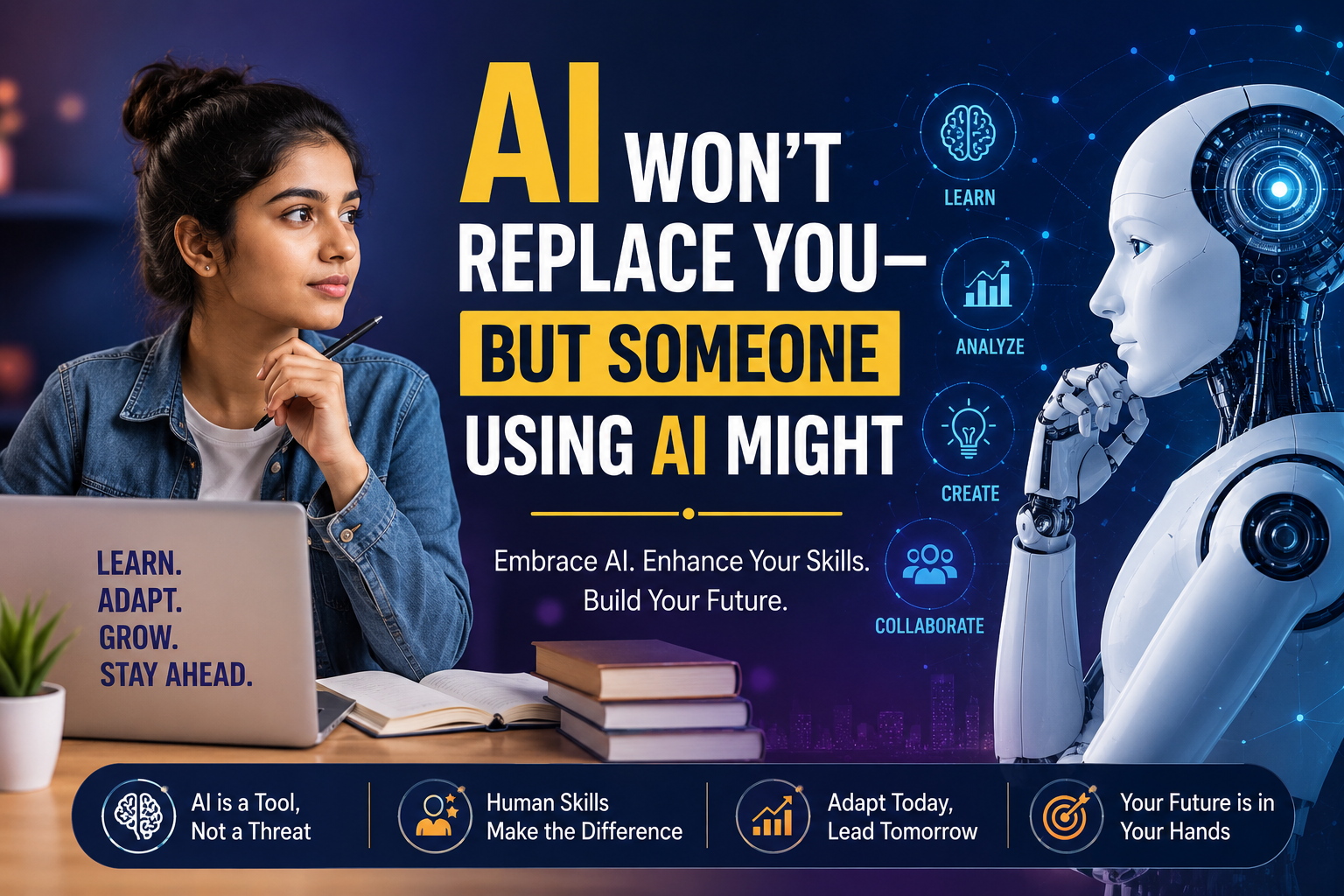
Artificial Intelligence (AI) is no longer a futuristic concept—it has become an essential part of education, business, healthcare, engineering, finance, marketing, and almost every other industry. From writing emails and analyzing data to designing graphics and automating repetitive tasks, AI is transforming the way people work. This rapid change has created a common fear among students and professionals: "Will AI replace my job?" The answer is more encouraging than many people think. AI is unlikely to replace individuals who continuously learn, adapt, and develop valuable human skills. However, someone who knows how to use AI effectively may outperform someone who refuses to embrace it. In today's competitive world, the real challenge is not competing against machines—it's competing against people who know how to work smarter with them.
For students, this is an important lesson. Academic knowledge alone is no longer enough to build a successful career. Employers are increasingly looking for individuals who can combine technical knowledge with problem-solving, creativity, communication, collaboration, and digital literacy. AI can help students research faster, organize information, improve writing, generate ideas, learn coding, practice interviews, and even create presentations. Instead of spending hours on repetitive tasks, students can use AI to save time and focus on understanding concepts, building projects, and developing practical skills. Those who learn to use AI responsibly gain a significant advantage in both academics and future employment.
At the same time, AI has its limitations. It cannot replace qualities such as empathy, ethical decision-making, leadership, emotional intelligence, critical thinking, innovation, and human relationships. These uniquely human abilities remain essential in every profession. A teacher inspires students beyond textbooks, a doctor comforts patients with compassion, a leader motivates teams during uncertainty, and an entrepreneur identifies opportunities that require vision and courage. AI can assist these professionals, but it cannot replace the human qualities that make their work meaningful.
The future workplace will reward people who view AI as a partner rather than a competitor. Whether you aspire to become an engineer, designer, entrepreneur, doctor, lawyer, teacher, or business leader, learning how to work with AI will become as important as learning to use a computer or the internet. Students who remain curious, continue learning, and adapt to new technologies will be better prepared for tomorrow's opportunities.
This is why career planning has become more important than ever. Choosing a career today is not just about selecting a degree—it is about understanding industry trends, identifying your strengths, and developing skills that will remain valuable in an AI-driven world. Career counselling can help students recognize their interests, evaluate their abilities, explore emerging career opportunities, and create a roadmap for long-term success. Making informed decisions today can prevent confusion and open doors to rewarding careers in the future.
The message is simple: don't fear AI—learn it, understand it, and use it wisely. Technology will continue to evolve, but the people who combine human intelligence with artificial intelligence will always have an edge. The future belongs to learners who are adaptable, innovative, and willing to grow with change. Remember, AI won't replace you—but someone who knows how to use AI effectively just might.