
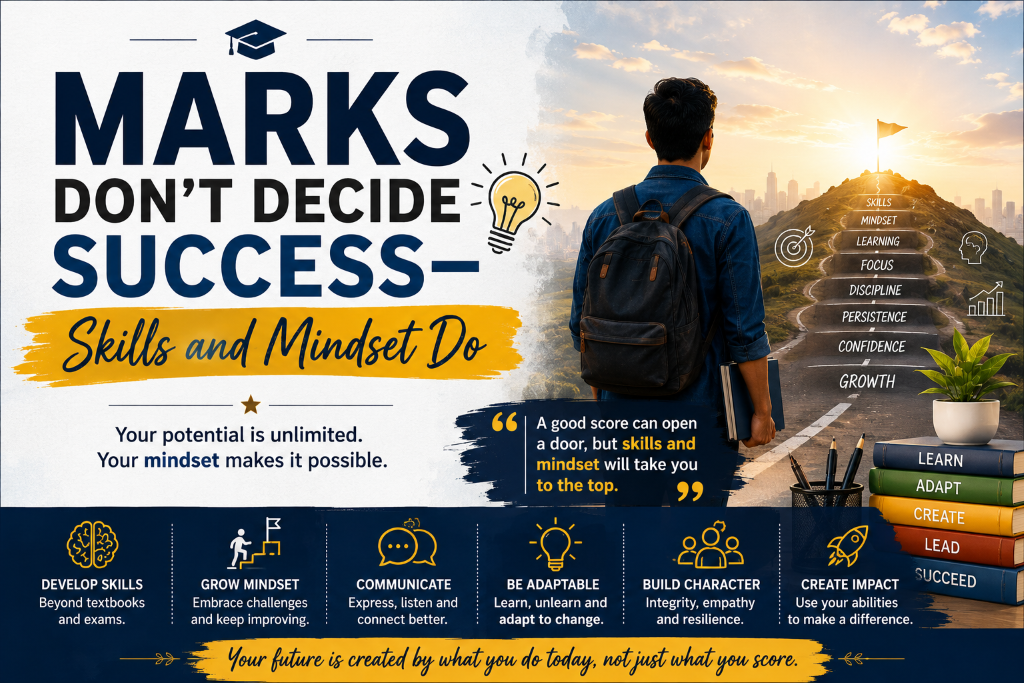
For many students, marks are often seen as the ultimate measure of success. Report cards, exam scores, and rankings can create the impression that a person's future depends entirely on academic performance. While good marks can open certain educational opportunities, they do not guarantee a successful career or a fulfilling life. In today's rapidly changing world, employers, universities, and entrepreneurs increasingly value practical skills, adaptability, creativity, communication, and a positive mindset alongside academic knowledge. Success is no longer defined by marks alone—it is shaped by what you can do with what you know.
Academic performance is important because it reflects discipline, effort, and subject knowledge. However, it represents only one aspect of a student's potential. Every individual has unique talents, interests, strengths, and ways of learning. Some students excel in examinations, while others demonstrate exceptional abilities in leadership, innovation, public speaking, design, technology, problem-solving, sports, or entrepreneurship. A single examination cannot measure qualities such as resilience, emotional intelligence, curiosity, teamwork, or determination—all of which play a significant role in long-term success.
The modern workplace is changing faster than ever before. Employers are looking for individuals who can communicate effectively, think critically, collaborate with diverse teams, solve real-world problems, and adapt to new technologies. As artificial intelligence and automation continue to transform industries, technical knowledge alone is no longer enough. Students who continuously learn new skills, embrace change, and remain open to innovation are more likely to succeed in the careers of the future.
Mindset is equally important. A growth mindset is the belief that abilities and intelligence can be developed through learning, effort, and persistence. Students with this mindset view challenges as opportunities rather than obstacles. They understand that mistakes are part of the learning process and use feedback to improve instead of giving up. Rather than comparing themselves with others, they focus on becoming better versions of themselves each day. This attitude builds confidence, resilience, and the courage to face uncertainty with determination.
Developing practical skills should become a regular part of every student's journey. Communication skills, digital literacy, leadership, financial awareness, creativity, time management, emotional intelligence, and critical thinking are valuable in almost every profession. Participating in internships, volunteering, workshops, online courses, competitions, and real-world projects allows students to apply their knowledge while building confidence and experience. These experiences often make a stronger impression on employers than marks alone.
Parents and educators also play an important role in shaping a student's perspective. Encouraging children to explore their interests, ask questions, solve problems, and develop life skills creates a healthy environment for growth. Celebrating effort, progress, and learning instead of focusing only on grades helps students build self-belief and a lifelong love of learning. Success is not about being perfect—it is about continuing to grow.
Career counselling can help students identify their strengths, interests, personality, and career aspirations beyond academic scores. Scientific career assessments and professional guidance enable students to make informed decisions based on their abilities and goals rather than social pressure or comparison. Understanding your unique potential helps you choose a path where you can thrive both personally and professionally.
Marks may help you enter a classroom, but your skills, mindset, and character will determine how far you go in life. The future belongs to those who are willing to learn continuously, adapt confidently, and turn knowledge into action. So, study with dedication, but never forget to build the skills, habits, and mindset that create lasting success. Because in the end, marks may open a door—but it is your abilities and attitude that will help you walk through it and build a meaningful future.