
It's late November, and the atmosphere at home has changed. The syllabus feels longer than it did last month. A friend says she has already finished two revisions. Another says he hasn't even started. Your parents ask, "How is the preparation going?" more often than usual, and each time your stomach tightens a little.
If this sounds familiar, you are not behind, and you are not alone. Almost every Class 10 and Class 12 student feels this pressure at this time of year. The good news is that eight weeks is a meaningful amount of time. It is not too little to make a difference, and it is not so much that you can relax. What matters now is how you use it.
Why Panic Doesn't Help (and a Little Pressure Does)
Psychologists Robert Yerkes and John Dodson described a principle, now known as the Yerkes-Dodson law, which suggests that performance is best at a moderate level of arousal. Too little pressure and we drift. Too much and our thinking narrows, our memory freezes and silly mistakes increase.
In other words, a little nervousness is normal and even useful. The goal is not to remove stress but to keep it at a level where you can think clearly. A clear plan is one of the best ways to do that, because it replaces vague fear with specific tasks.
What Science Says About Studying Better
Before the plan, a few findings from learning research are worth knowing, because they can change how you use your hours:
- Retrieval practice. Researchers such as Henry Roediger and Jeffrey Karpicke have shown that testing yourself, by closing the book and writing what you remember, strengthens memory more than simply re-reading. Re-reading feels productive, but it is often less effective than it seems.
- Spaced repetition. Reviewing a topic at increasing intervals, for example after a day, then a week, helps you remember it longer than cramming it all at once. This is related to what psychologist Hermann Ebbinghaus described as the forgetting curve.
- Interleaving. Mixing different types of problems or topics in one session, rather than doing only one type for hours, can improve your ability to choose the right method during an exam.
- Sleep. Memory consolidation happens during sleep, so cutting sleep to study more often backfires.
You don't need to remember the names. Just remember the habits: test yourself, revisit topics over time, mix practice and sleep well.
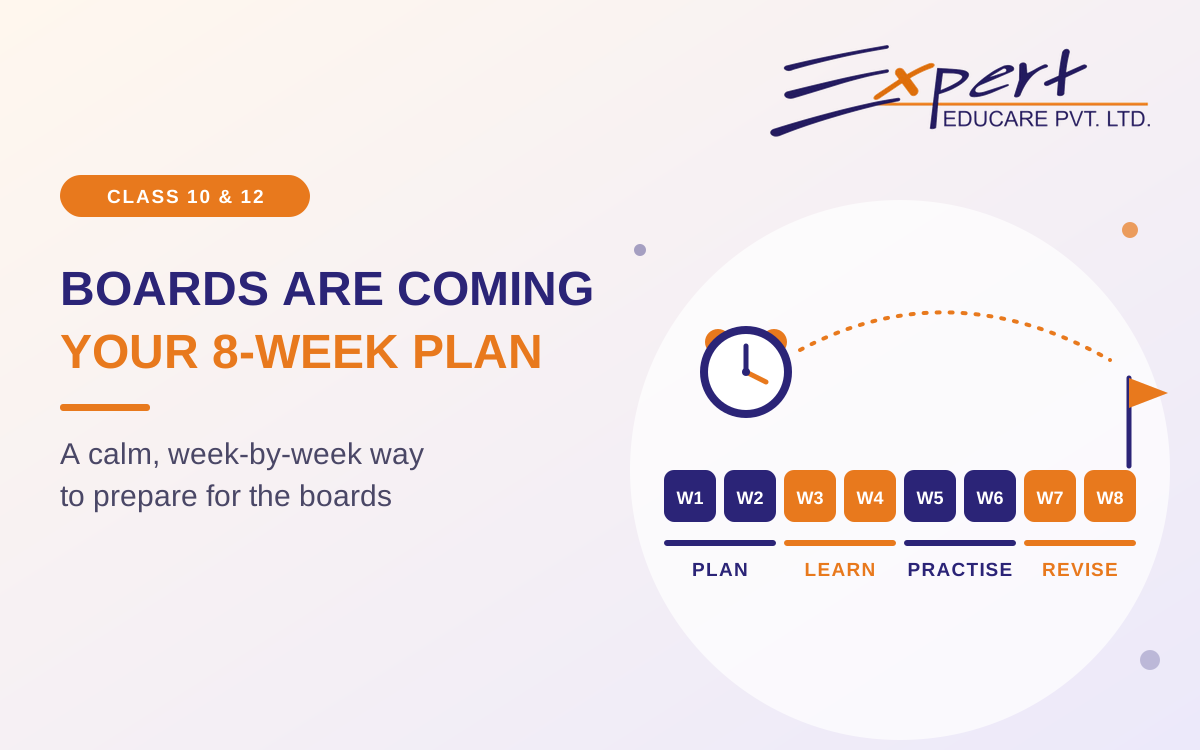
Your 8-Week Plan
This is a flexible framework. Adjust it to your board, your subjects and your pace.
Weeks 1 and 2: Plan and Assess
- Collect the full syllabus, the marking scheme and the last few years' question papers.
- List every chapter in every subject and mark each one: strong, medium or weak.
- Note the weightage of each topic. Spend more time where marks are high and you are weak.
- Create a weekly timetable with fixed study blocks, breaks and one lighter day.
- Set up a simple "error notebook" where you will write down every mistake you make from now on.
Weeks 3 and 4: Learn and Strengthen
- Begin with your weak and high-weightage chapters while your mind is fresh.
- Use active methods: explain concepts aloud, draw diagrams, make short notes and flashcards.
- Clear doubts early. Ask teachers or friends instead of leaving them for later.
- Do not try to finish everything. Aim for depth in the important areas first.
Weeks 5 and 6: Practise Under Exam Conditions
- Solve full papers with a timer, in a quiet space, as you would in the exam hall.
- Check your answers carefully, and write down the reason for every mistake in the error notebook: concept gap, silly error, time pressure or misreading the question.
- Practise presenting answers neatly, since clear presentation and steps matter in many subjects.
- Revisit topics you got wrong within a day or two, then again after a week.
Week 7: Revise and Refine
- Go through your short notes, formulas, diagrams and error notebook instead of reading full chapters again.
- Test yourself on key points without looking.
- Fix the top five recurring mistakes you have noticed.
- Keep one or two practice papers for the final stretch.
Week 8: Consolidate and Calm Down
- Revise lightly, and do not start any big new topic.
- Prepare practical items: admit card, stationery and the route to your exam centre.
- Protect your sleep, meals and daily movement. These are part of preparation.
- Spend a little time each day doing something you enjoy.
A Sample Daily Routine
- Morning: 2 to 3 hours on your most demanding subject.
- Midday: a break, a proper meal and a short walk.
- Afternoon: 2 hours of practice questions or papers.
- Evening: 1 to 2 hours of lighter revision or a subject you enjoy.
- Night: a quick review of what you learned, and sleep on time.
Short breaks every 45 to 60 minutes help you stay focused. Keep your phone away during study blocks, since even a quick glance can break your concentration.
For Class 10 Students: The Stream Question Is Coming Too
Many Class 10 students are so busy with boards that they postpone thinking about what comes next. But stream selection arrives soon after the results, and choosing in a hurry often leads to regret. While preparing for the exams, set aside a little time to notice which subjects you enjoy, which come naturally and what kind of work interests you. A guided conversation with a counsellor before results can make the decision far calmer later.
For Class 12 Students: Boards and What Comes Next
Class 12 students often juggle boards with entrance exams and college applications. List the exams you plan to take, their dates and their syllabus overlap with the board syllabus, so you can use your time wisely. It is also a good moment to confirm that your preferred course and career path really suit you, instead of following the crowd.
A Note for Parents
Your child can sense your worry even when you don't say it. Constant comparisons, daily marks checks and frequent reminders usually add stress without adding effort. What helps more is a calm home, regular meals, a quiet study space, and a simple question like, "What would make this week easier for you?" Students perform better when they feel supported rather than watched.
When to Seek Extra Support
A little anxiety before exams is normal. But if a student is struggling with persistent sleeplessness, loss of appetite, constant worry, panic or feelings of hopelessness, it is important to speak to a counsellor, doctor or mental health professional. Asking for help is a sign of strength, and the sooner it happens, the easier it is to manage.
How Career Counselling Can Help
Exam preparation becomes much easier when you know why you are working towards a result. A career counsellor can help students understand their strengths, interests and options, whether it is choosing a stream after Class 10 or a course after Class 12, so that effort is directed towards a goal that actually fits. At Expert Educare, we have helped students and parents with these decisions since 2005.
Eight Weeks Is Enough to Begin Well
Boards are important, but they are one step in a long journey. A steady plan, good habits and a calm mind will serve you far better than late-night panic. Start with a small step today. Write down your chapters, mark your weak areas and fix your first study block for tomorrow.
If you are unsure about your next step after boards, you don't have to figure it out alone. Expert Educare's career counselling can help you choose a path with clarity and confidence. To learn more, visit Expert Educare.