
Comparing your child to “Sharma ji ka beta” lowers their confidence; it doesn’t build a career. Here’s what helps instead.
It’s dinner time, and the report cards are on the table. Somewhere between the second roti and the third sigh, someone says it: “Look at Sharma ji’s son. He has already cleared the entrance exam.” Your child stares at the plate. The room goes quiet, and nobody feels better.
If you are a parent who has said something like this, you are not a bad parent. You said it because you are worried, because you love your child and the world feels competitive. And if you are a student who has heard it too many times, you are not lazy or behind. You are simply growing at your own pace, in a house that is afraid for your future.
Today is Universal Children’s Day, which makes it a good time to pause and ask a gentle question: what does comparison actually do to the child we are trying to help?
Why Comparison Feels Natural (and Why It Backfires)
In 1954, psychologist Leon Festinger described social comparison theory: people judge their own abilities by measuring themselves against others. It is a deeply human habit. Parents do it too, because it gives us a quick way to check whether our child is “on track.”
The problem is that the track is rarely the same for everyone. A child who is slower in mathematics may be exceptional at communication. A student who seems directionless at 17 may find real clarity at 22. Comparison looks at one narrow slice of a child’s life and treats it as the whole picture.
For the child, the message that lands is rarely “improve.” It is “I am not enough as I am.” And a child who feels this way often stops trying, hides mistakes or avoids challenges altogether, the exact opposite of what the parent wanted.
The Pygmalion Effect: What We Expect, We Often Get
In the 1960s, researchers Robert Rosenthal and Lenore Jacobson found that when teachers were led to expect more from certain students, those students tended to show greater progress. This became known as the Pygmalion effect: our expectations quietly shape how people behave.
Now think about what happens at home. A child who is constantly told “you’re behind” may start believing it. A child who hears “I believe you will figure this out” is far more likely to keep trying. Words at the dinner table are never just words. They become the voice a child carries into every exam hall and interview room.
Why Career Timelines Are Not the Same
We often imagine a career as a straight line: good marks, the right stream, a top college, a good job, all by a certain age. Psychologist Bernice Neugarten called this the social clock, the unwritten timeline society sets for when things should happen.
Real careers look very different. Some students find their direction early. Others try two or three paths first. Some need a gap year, a change of course or a few unrelated jobs before things click. Psychologist James Marcia, who studied identity development, observed that young people often need a period of exploration before they can truly commit to a path. Skipping that exploration doesn’t speed things up. It often leads to choices that are later regretted.
In other words, a child who is “late” by someone else’s calendar may be doing exactly the thinking they need to do.
How Comparison Quietly Affects Students
- Confidence drops. Constant comparison teaches children to measure their worth through other people’s results.
- Fear of failure grows. If mistakes lead to comparison, students start avoiding risks.
- Interests get buried. A child may drop a subject they enjoy because it doesn’t look impressive next to a cousin’s achievements.
- Relationships get strained. Children may start hiding marks, plans and worries from parents to avoid another comparison.
- Stress builds silently. Many students carry this pressure without ever saying it aloud.
What to Do Instead: A 5-Step Reset for Parents
- Compare your child only to their past self. Notice growth, however small. “Your communication in the interview was better than last time” is far more useful than any ranking.
- Replace “Why not you?” with “What do you need?” The first question shames. The second invites a conversation.
- Look for strengths beyond marks. Leadership, creativity, empathy, curiosity, persistence. Careers are built on these as much as on percentages.
- Ask questions about their interests. “What did you enjoy most this week?” can reveal more about a future career than a marksheet.
- Be the safest place to fail. Psychologists Edward Deci and Richard Ryan found that people grow best when they feel supported and have a sense of choice in their decisions. When children know that a bad result won’t cost them your love, they take healthier risks and learn faster.
A Note for Students
If you are the one being compared, here are a few things worth remembering. Your parents’ comparisons usually come from fear, not from a lack of faith in you. Try telling them calmly how it makes you feel, at a time when nobody is already upset. And remember that LinkedIn posts and family stories show only the highlights. They rarely show the struggle, the doubts or the detours that happened in between.
When to Seek Extra Support
Occasional stress about the future is normal. But if a student seems withdrawn for weeks, loses interest in things they once enjoyed, struggles with sleep or appetite, or speaks hopelessly about themselves, it is important to talk to a counsellor, doctor or mental health professional. Reaching out is a sign of care, not of failure.
Where a Career Counsellor Can Help
Sometimes families go around in circles because everyone has an opinion and nobody has clear information. A career counsellor looks at the student’s interests, strengths and personality, and helps the whole family see the options without pressure. At Expert Educare, we have helped students and parents find direction since 2005, and often one honest conversation is enough to replace worry with a plan.
Every Seed Has Its Own Season
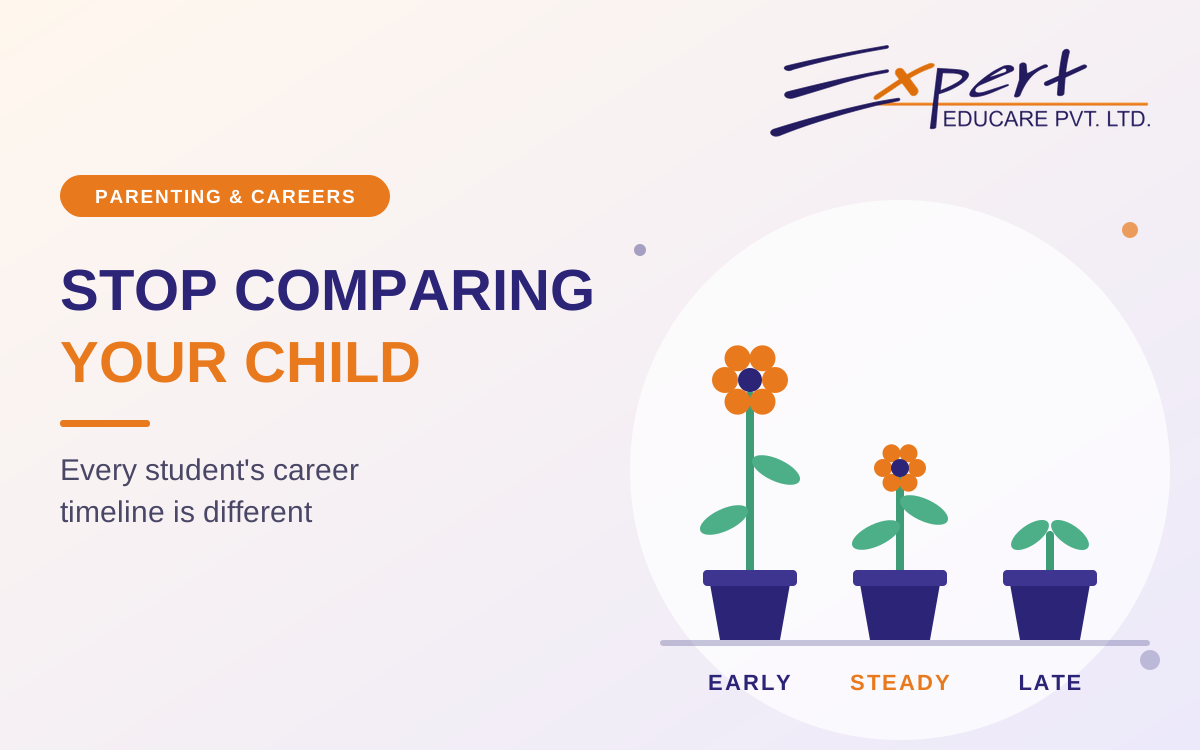
Not every plant flowers at the same time. Some bloom early, some take their time, and some surprise everyone late in the year. No gardener pulls a seedling up to check why it hasn’t bloomed like the plant next to it. They give it light, water and patience.
Children deserve the same. So the next time “Sharma ji ka beta” is about to come up at the dinner table, try something different. Ask your child how they are feeling, what excites them and how you can help. The answer may be the beginning of a career conversation that finally goes somewhere.
If you are a parent or student feeling stuck on career decisions, you don’t have to figure it out alone. Expert Educare’s career counselling can help you find a path that fits the child, not the comparison. To learn more, visit Expert Educare.