
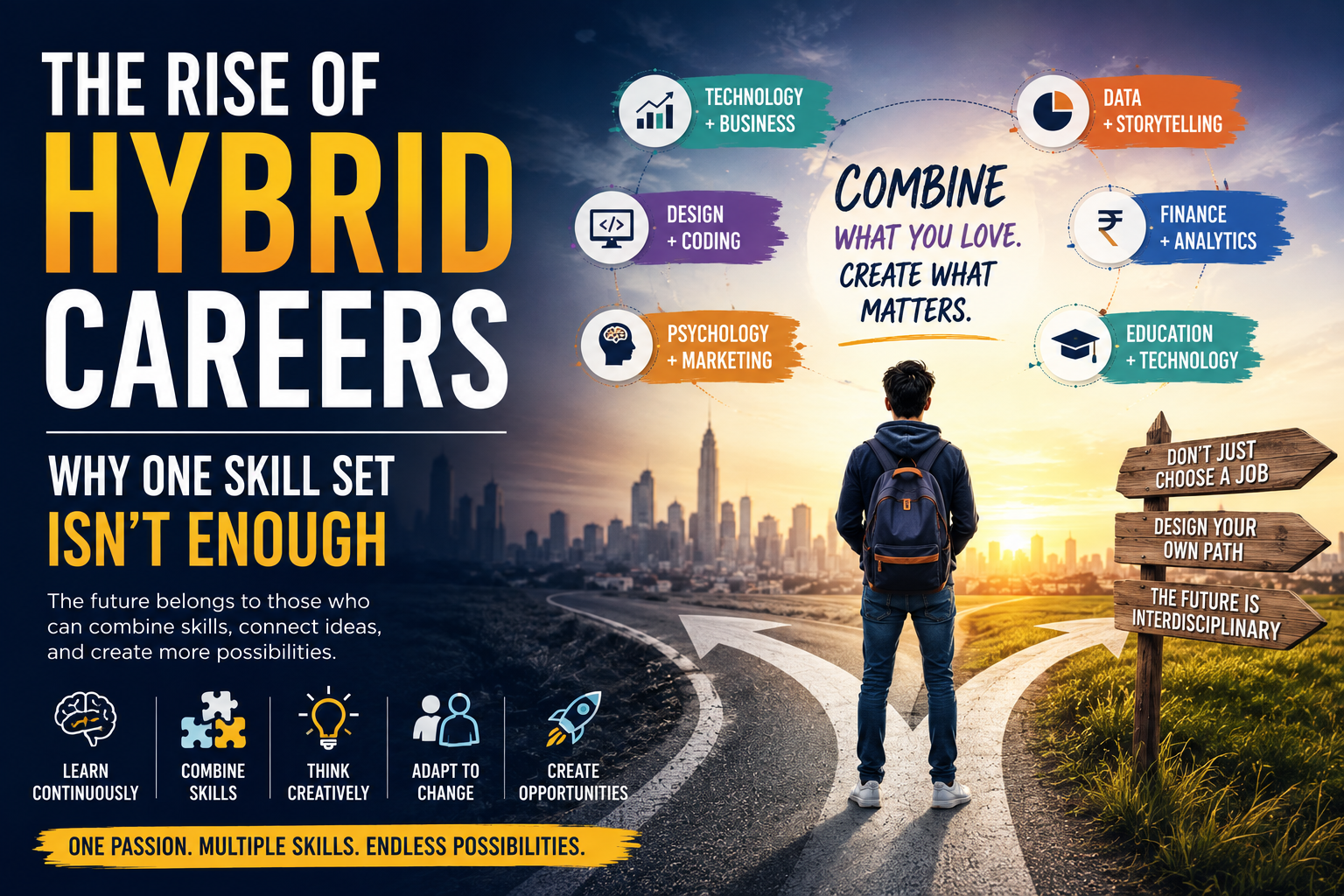
The world of work is changing faster than ever before. Careers that once followed a simple path of choosing one subject, earning a degree, and building a profession around it are increasingly being replaced by more flexible and interconnected career paths. Today, success is no longer determined only by how much you know about one particular field. It is increasingly shaped by your ability to combine knowledge, skills, creativity, technology, communication, and adaptability. This is where the concept of hybrid careers is becoming increasingly important. A hybrid career is a career that combines skills or knowledge from two or more different fields to create a unique professional profile. Instead of being defined by just one skill, hybrid professionals bring together multiple abilities that complement each other. For example, someone with knowledge of technology and business can work in product management, while a person who combines psychology and marketing can build a career in consumer behaviour. A designer who understands coding can move into UI/UX or product design, while a teacher who understands digital tools can explore educational technology. These combinations create opportunities that may not exist when skills are viewed separately. The rise of artificial intelligence, automation, digital platforms, and rapidly changing industries is one of the biggest reasons hybrid careers are becoming more valuable. Technology can automate many repetitive tasks, but it also creates new roles that require people to connect different areas of knowledge. Businesses increasingly need professionals who can understand technology while also understanding people, communication, strategy, creativity, or business needs. This means that being highly specialized in one area can still be valuable, but combining that specialization with complementary skills can create an even stronger career advantage. Consider the difference between knowing how to use a technology and knowing how to use it to solve a real-world problem. Technical knowledge may help someone build a product, but understanding users, communication, business strategy, and design can help them build something people actually want. Similarly, knowing marketing techniques is useful, but combining marketing with data analysis can help a professional make smarter decisions based on customer behaviour. The real advantage comes from connecting knowledge rather than keeping it isolated. Hybrid careers are also changing the way students should think about education. Instead of asking only, "Which degree should I choose?" students can begin asking, "Which combination of skills can help me create unique opportunities?" A student studying computer science might explore entrepreneurship, communication, design, finance, or psychology. A student studying commerce might develop skills in data analytics, digital marketing, technology, or content creation. Someone interested in psychology could explore human resources, organisational behaviour, counselling, education, or consumer research. The possibilities are much wider when education is viewed as a foundation rather than a limitation. Another major advantage of hybrid skills is adaptability. Industries can change, technologies can become outdated, and job descriptions can evolve, but professionals who know how to learn across different areas are better prepared to adjust. Imagine a professional who only knows one software tool. If that tool becomes outdated, their career may become more difficult. But someone who understands the principles behind technology, problem-solving, communication, and continuous learning can adapt to new tools much more easily. In this sense, adaptability itself becomes a career skill. Hybrid careers also allow people to differentiate themselves in competitive job markets. When hundreds of candidates possess similar degrees and technical qualifications, a unique combination of skills can help someone stand out. A candidate who combines data analysis with storytelling, technology with communication, or finance with digital marketing may bring a perspective that others do not. Employers are often looking for people who can solve problems, collaborate across teams, communicate ideas clearly, and understand the bigger picture. These abilities often come from combining different areas of knowledge. However, building a hybrid career does not mean trying to become an expert in everything. In fact, attempting to learn too many unrelated skills can create confusion rather than advantage. The goal is to develop a strong core skill and then add complementary skills around it. Think of it as building a "T-shaped" skill profile: deep expertise in one area combined with broader knowledge across related areas. For example, a person might develop deep expertise in software development while also learning communication, project management, and business strategy. Another person might specialize in graphic design while developing knowledge of branding, marketing, and user experience. The combination makes the professional profile stronger without requiring mastery of every field. Students can begin building hybrid skills much earlier than they may realize. They do not need to wait until graduation. Online courses, workshops, internships, volunteering, student projects, competitions, freelancing, and personal projects can all provide opportunities to explore different fields. A student interested in technology and communication could start a technology blog or create educational videos. Someone interested in business and design could work on a small branding project. A student interested in psychology and education could explore topics related to learning and student behaviour. These experiences help students discover what they enjoy while developing practical skills. Hybrid careers can also create more freedom. Instead of being limited to a single traditional job title, professionals may find opportunities across multiple industries. Someone with a combination of technology and healthcare knowledge might work in health-tech. Someone combining environmental knowledge and business could explore sustainability consulting. A person with education and technology skills might work in EdTech. The combination of fields can open doors that a single traditional career path might not. Most importantly, hybrid careers encourage us to rethink what career success looks like. A successful career does not necessarily mean following one fixed path for decades. It can mean continuously learning, combining experiences, discovering new interests, and adapting as the world changes. The career journey can evolve as you gain more knowledge about yourself and the opportunities around you. For students, this is an encouraging message: you do not have to know your entire professional future today. Instead, focus on building a strong foundation, exploring your interests, developing transferable skills, and staying curious. Your career may eventually emerge from the intersection of several things you enjoy and do well. In a rapidly changing world, the question is no longer simply, "What is your one biggest skill?" A better question is, "How can your skills work together to create something valuable?" The future may belong to professionals who can connect technology with humanity, creativity with strategy, knowledge with communication, and expertise with adaptability. One skill can help you enter a career, but a combination of skills can help you grow, adapt, and create new opportunities. The rise of hybrid careers reminds us that our professional identity does not have to fit into a single box. Your unique combination of knowledge, experiences, interests, and abilities could become your greatest career advantage. Instead of asking yourself which single path you should follow, start exploring where your different strengths intersect. That intersection may be where your most exciting career opportunities begin.