
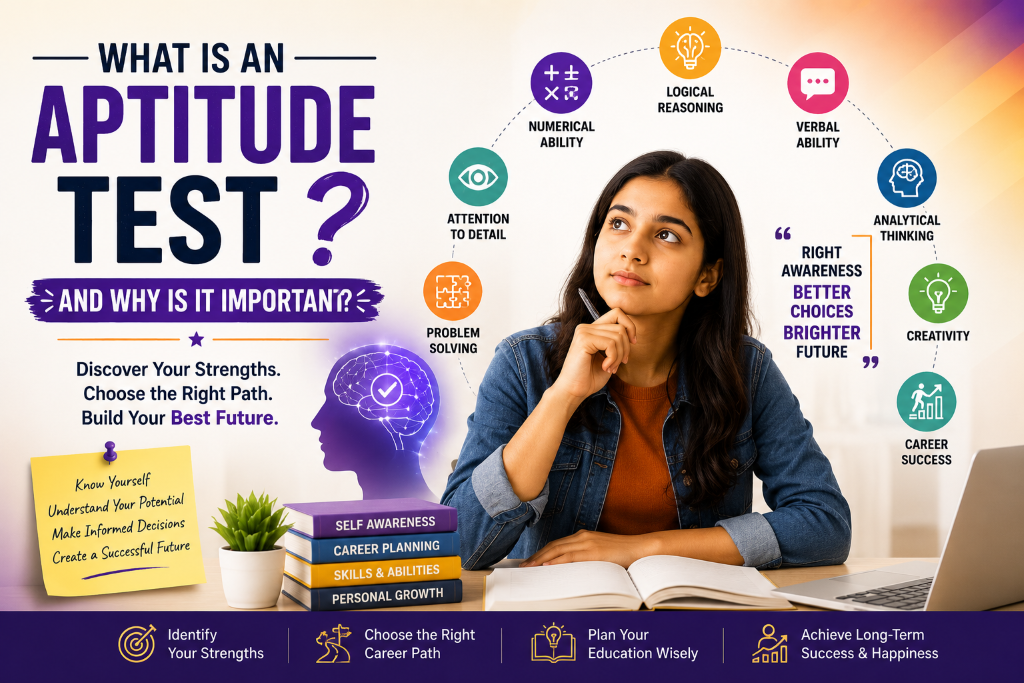
Choosing the right career is one of the most significant decisions in a student's life. Yet, many students make this decision based on marks, family expectations, peer influence, or the popularity of a particular profession rather than understanding their own abilities and interests. While academic performance reflects how well a student has learned specific subjects, it does not always reveal what they are naturally capable of achieving in the future. This is where an aptitude test becomes an invaluable tool. Rather than predicting success through grades alone, an aptitude test helps uncover a student's inherent strengths, learning potential, and natural talents, enabling them to make informed and confident career choices.
An aptitude test is a scientifically designed assessment that evaluates a person's natural abilities across various skill areas. It measures how well an individual is likely to perform in specific tasks or professions by assessing capabilities such as logical reasoning, numerical ability, verbal communication, analytical thinking, creativity, spatial intelligence, problem-solving, memory, attention to detail, and decision-making. Unlike traditional examinations, there are no right or wrong career choices based on the results. Instead, the test provides valuable insights into areas where a student has the greatest potential to excel.
One of the biggest misconceptions about aptitude tests is that they determine intelligence. In reality, aptitude and intelligence are not the same. Intelligence reflects a person's overall ability to learn and understand concepts, whereas aptitude identifies the specific areas in which an individual naturally performs well. For example, a student may have exceptional creative thinking and communication skills but average mathematical ability. Another student may demonstrate outstanding analytical reasoning and technical aptitude while preferring structured problem-solving over creative expression. Recognizing these differences helps students select career paths that align with their unique strengths rather than forcing themselves into professions that may not suit their abilities.
The importance of aptitude testing has grown significantly as career opportunities continue to expand. Today's students can choose from hundreds of professions across technology, healthcare, finance, business, law, design, digital marketing, artificial intelligence, data science, environmental studies, hospitality, sports management, psychology, entrepreneurship, and many other emerging industries. With so many possibilities, making a career decision without understanding one's aptitude can lead to confusion, dissatisfaction, and frequent career changes. An aptitude assessment provides clarity by narrowing down options that match an individual's natural capabilities and interests.
Another major advantage of aptitude testing is increased self-awareness. Many students are unaware of their hidden strengths because they focus only on academic subjects or compare themselves with others. An aptitude test helps them discover abilities they may never have recognized, boosting confidence and encouraging them to explore opportunities that genuinely match their potential. This self-understanding reduces uncertainty and empowers students to make career decisions based on evidence rather than assumptions or external pressure.
Aptitude tests are equally beneficial for parents. Every parent wants their child to succeed, but choosing a career based solely on personal expectations or traditional professions may not always lead to long-term happiness. Aptitude assessments provide objective insights that help parents better understand their child's abilities, making career discussions more constructive and less stressful. Instead of disagreements about career choices, families can work together using scientific data to identify educational paths that align with both the student's strengths and future career opportunities.
Career counsellors also rely on aptitude tests to provide personalized guidance. Rather than offering generic advice, counsellors combine aptitude results with personality assessments, interests, academic performance, and career goals to recommend suitable educational pathways and professions. This holistic approach ensures that students receive guidance tailored specifically to their unique profiles, increasing their chances of long-term satisfaction and success.
It is important to understand that an aptitude test does not decide a student's future or limit their possibilities. It serves as a guide, not a final verdict. Passion, dedication, continuous learning, resilience, and hard work remain essential ingredients for success in any profession. A student with average aptitude in a particular field can still achieve remarkable results through determination and consistent effort. Likewise, natural talent alone cannot guarantee success without discipline and commitment. Therefore, aptitude testing should be viewed as one important component of career planning rather than the only deciding factor.
Taking an aptitude test at the right stage—whether after Class 10, Class 12, during graduation, or even while considering a career change—can significantly reduce confusion and help students make informed decisions before investing years of education and resources into a profession. Early career planning saves time, minimizes unnecessary stress, and allows students to focus on developing the skills most relevant to their chosen path.
Ultimately, an aptitude test is not about telling students what they must become; it is about helping them discover who they already are. When combined with self-awareness, career counselling, personal interests, and future aspirations, aptitude testing becomes a powerful foundation for building a meaningful and successful career. The most rewarding career is not necessarily the one that is most popular or prestigious—it is the one that aligns with a person's natural strengths, values, and purpose. Understanding your potential is the first step toward unlocking a future where success is built on confidence, capability, and informed decision-making.