
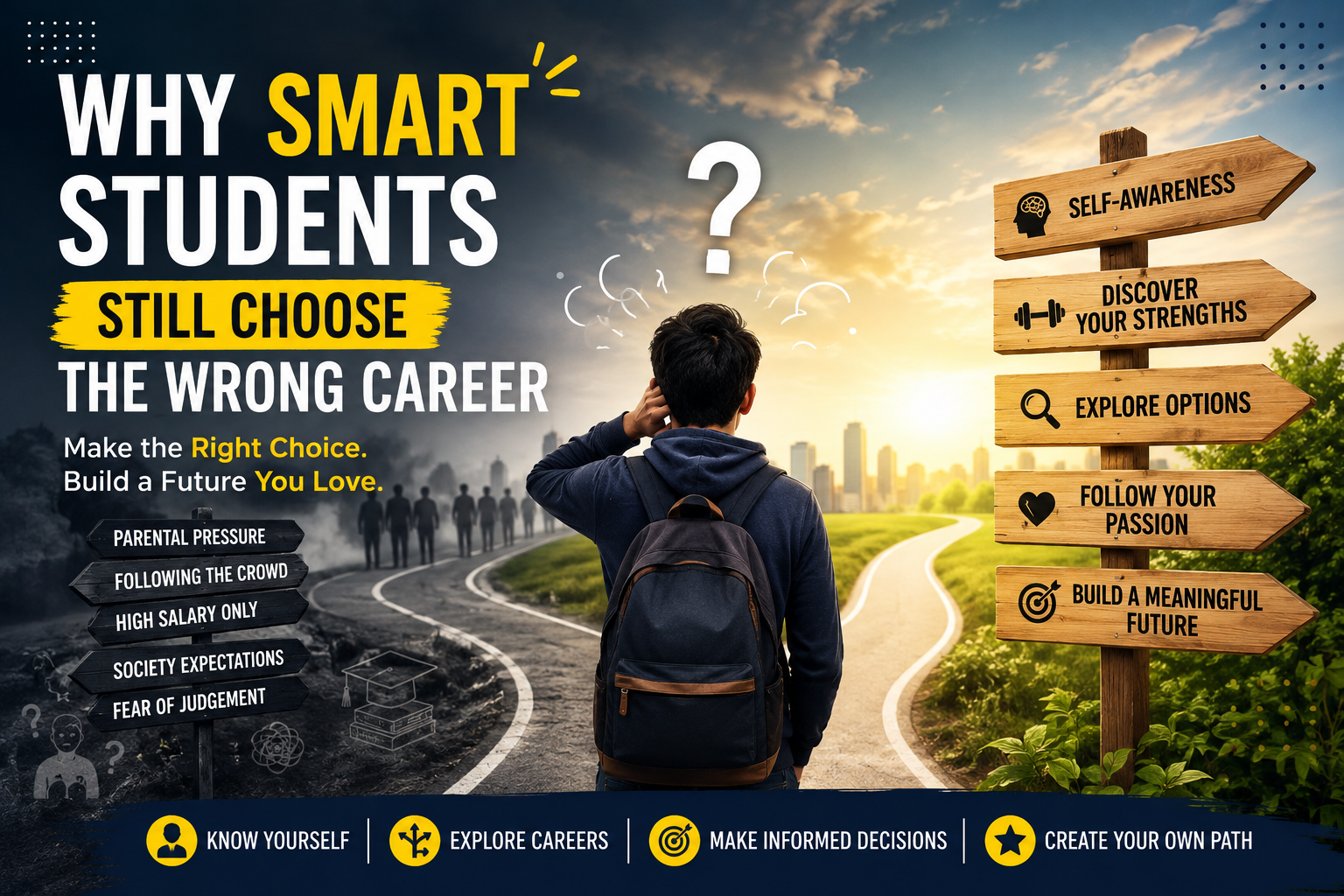
Every year, thousands of intelligent and hardworking students achieve excellent grades, earn prestigious degrees, and make their families proud. Yet, many of them eventually realize they are unhappy with the careers they have chosen. This raises an important question: Why do smart students still choose the wrong career? The answer lies in understanding that academic intelligence is very different from career intelligence. Scoring high marks proves a student's ability to learn and perform in examinations, but it does not automatically reveal their interests, personality, strengths, values, or long-term aspirations. Unfortunately, our education system often focuses on academic success while giving very little attention to self-discovery. As a result, students are taught how to solve mathematical equations and memorize scientific concepts but rarely encouraged to ask themselves important questions like, "What kind of work excites me?", "What are my natural strengths?", "Which environment allows me to thrive?", or "What kind of life do I truly want to build?" Without answers to these questions, even the brightest students can make career decisions based on external influences rather than personal understanding. One of the biggest reasons students choose the wrong career is societal pressure. From an early age, many hear statements such as "Engineering is the safest career," "Doctors earn respect," "Government jobs provide lifetime security," or "Choose the profession with the highest salary." These opinions often become louder than the student's own dreams and aspirations. Over time, many begin to believe that success is defined by social approval rather than personal fulfillment. Another common reason is the pressure created by high academic performance. Students who consistently score well often feel obligated to choose careers that match their marks instead of careers that match their passions. They believe that good grades should naturally lead to professions considered prestigious by society, even if those professions do not align with their interests. High marks can certainly open doors, but they cannot decide which door is right for an individual. A lack of self-awareness also plays a major role in poor career decisions. Every person possesses unique talents and abilities. Some are natural leaders who enjoy guiding others, while some excel at analytical thinking and problem-solving. Others have exceptional creativity, communication skills, empathy, business acumen, artistic talent, or a passion for research and innovation. When students fail to recognize these strengths, they may enter careers where their true potential remains hidden. Fear is another powerful factor. Many students secretly dream of becoming entrepreneurs, designers, psychologists, researchers, filmmakers, content creators, social workers, environmental scientists, or sports professionals. However, fear of failure and uncertainty often pushes them toward more conventional career paths simply because they appear safer or more accepted. Choosing security over passion may feel comfortable initially, but it can eventually lead to dissatisfaction and regret. Limited career awareness further contributes to poor decisions. Many students know only a handful of professions because those are the careers commonly discussed within families and schools. In reality, today's world offers thousands of exciting opportunities in fields such as Artificial Intelligence, Data Science, Cybersecurity, Digital Marketing, UX/UI Design, Renewable Energy, Healthcare Technology, International Business, Psychology, Education Technology, Sustainability, Animation, Robotics, and many more. Without proper career guidance and exposure, students may never discover careers that perfectly match their abilities and interests. Comparison also creates unnecessary confusion. Students often compare themselves with classmates, relatives, or friends who are pursuing engineering, medicine, government jobs, or studying abroad. Instead of making thoughtful career decisions based on their own strengths and aspirations, they begin following the paths chosen by others. However, every individual is unique, and no two career journeys are the same. Success cannot be achieved by copying someone else's destination. Students should also ask themselves a few honest questions before making a career decision: Am I choosing this career because I genuinely enjoy it? Would I still choose this profession if nobody judged my decision? Does this career match my personality and values? Can I imagine myself happily working in this field for many years? If the answer to most of these questions is "No," it may be time to explore more options before making a final commitment. The first step toward choosing the right career is self-discovery. Students should identify their interests, personality, strengths, values, learning style, and preferred work environment before selecting a profession. Exploring different industries, attending career seminars, speaking with professionals, participating in internships, and gaining real-world experience can provide valuable insights that no textbook can offer. Equally important is developing essential life skills such as communication, critical thinking, emotional intelligence, leadership, creativity, adaptability, and problem-solving because employers increasingly value these qualities alongside academic qualifications. Professional career counselling can also make a significant difference by helping students understand themselves through scientifically designed psychometric assessments and expert guidance. Instead of making decisions based on assumptions, trends, or pressure, students can make informed choices that align with their true potential. A single career counselling session has the power to prevent years of confusion, dissatisfaction, and career changes. Ultimately, success is not about choosing the most popular profession or earning the highest salary; it is about finding meaningful work that aligns with who you are as a person. When your career reflects your strengths, interests, personality, and values, learning becomes enjoyable, challenges become opportunities, and success becomes both meaningful and sustainable. Being smart is undoubtedly an advantage, but wisdom lies in understanding yourself before choosing your future. Your career is not a race against others—it is a journey toward discovering your purpose and becoming the best version of yourself. Taking time to make an informed career decision today can lead to a lifetime of confidence, growth, fulfillment, and happiness. At Career & Culture, we believe every student deserves guidance that goes beyond marks and rankings. Through personalized career counselling, psychometric assessments, and expert mentoring, we empower students to discover careers that truly align with their potential, ensuring they build not just successful careers but meaningful lives.